Search Results
9953 results found with an empty search
- Refreshing Examples of Digital Transparency That Are Changing The Industry
Something has shifted in the relationship between organizations and the people they serve. Companies are no longer just publishing annual reports or issuing press releases; they are opening up supply chains, salary structures, AI models, and data pipelines to full public view. This move toward radical openness is not driven by regulation alone. It is driven by a market that has learned to distrust vague claims and demand verifiable proof. From retail to healthcare to technology, the organizations gaining the most ground are those willing to show their work completely. The Growing Value of Sports Data Transparency: In the sports industry, digital transparency is reshaping fan trust, athlete health, and fair play by opening up data that was historically kept behind closed doors. Player performance metrics, injury protocols, officiating guidelines, and league financials are increasingly accessible, not just for general interest, but for in-depth analysis. The wider availability of this information has also fueled the growth of sports prediction platforms, allowing users to base their decisions on statistical trends and verified data rather than intuition alone. As prediction tools have become more sophisticated, they have attracted a broader audience looking for evidence-based insights before making predictions or engaging with betting-related platforms. Since prediction platforms and betting services now carry real financial weight for their users, knowing which one is reliable and transparent matters enormously. This is one of the reasons why the sportsbook review database on Betting.net was built: to give users a structured, honest resource for evaluating platforms based on documented criteria rather than promotional claims. Transparency at the platform level, showing how operators are reviewed, what standards are applied, and how ratings are calculated, is now as important as transparency within the sport itself. How Retail Brands Are Using Transparency to Earn Real Trust: Retail has historically been one of the least transparent sectors when it comes to supply chains and pricing. That is changing fast. Patagonia's Footprint Chronicles is one of the most cited examples, an interactive map that lets shoppers trace exactly which textile mills and sewing factories produced their clothing, including employee counts and environmental impact data for each location. It does not hide uncomfortable findings. That honesty is exactly what builds long-term loyalty. Everlane takes a different approach by publishing the precise breakdown of every product's cost: materials, labor, hardware, duties, and transport, followed by their markup. Shoppers see the math before they buy. Asket goes further with a garment-level Traceability Receipt that tracks each item from raw cotton farms to final shipping yards. Allbirds prints a verified carbon footprint number directly on every shoebox, backed by auditable manufacturing data. These brands are not making vague sustainability claims; they are offering documentation that can actually be checked. Third-party tools are accelerating this shift. Provenance integrates directly into e-commerce product pages, converting marketing language like "organic" or "cruelty-free" into verifiable, click-through proof. Oritain uses isotopic fingerprinting to confirm that raw materials like cotton or wool originate from ethical farms rather than high-risk supply chains. Retailers partnering with these platforms give consumers an audit trail that previously did not exist at the point of sale. Healthcare and Pharma: Making the Invisible Visible: Healthcare has long operated behind layers of institutional complexity that made pricing, treatment logic, and data access nearly impossible for patients to understand. Mark Cuban's Cost Plus Drug Company dismantled that model by publishing the actual wholesale cost of generic medications alongside a flat 15% markup, a fixed pharmacy fee, and transparent shipping charges. There are no hidden tiers or opaque insurance negotiations, just a readable price breakdown available to anyone. Apple Health extended this principle to personal data by adopting FHIR interoperability standards, giving patients plain-language visibility into which hospitals, researchers, and applications are accessing their medical records at any given time. Platforms like Zocdoc have built open, unedited patient review systems for medical providers, creating verified records of wait times and provider behavior. Talix uses AI to extract structured data from clinical records so that insurers and medical institutions can audit exactly why specific billing codes were generated. These tools remove the opacity that has historically made healthcare one of the most difficult industries for consumers to navigate. Technology Companies Opening Their Operational Ledgers: Buffer, the social media scheduling platform, publishes its entire company financials in real time, salaries by role, equity formulas, revenue figures, and diversity data. Every number is public and updated continuously. This level of internal openness is rare in any industry, but Buffer's ongoing experiment has demonstrated that radical corporate transparency can function as a genuine recruitment and retention advantage rather than a liability. BigID maps how consumer data moves through enterprise systems, making compliance auditing a visible process rather than a backend function. Hugging Face publishes detailed Model Cards and Dataset Cards for every AI system on its platform, revealing training data sources, bias assessments, and known limitations before any model reaches deployment. Mozilla runs its browser ecosystem through open GitHub repositories, allowing independent developers to inspect code for privacy flaws and telemetry tracking at any time. DuckDuckGo maintains a publicly readable tracking whitelist and open-source blocklists that document exactly which third-party scripts are neutralized during browsing sessions. Figma publishes live uptime dashboards with minute-by-minute service status updates, detailed post-mortem logs, and architectural bug fix documentation. These companies are not just claiming to be trustworthy; they are showing users the structure behind every claim. Public Sector Transparency Setting the Standard: Governments and logistics operators are contributing some of the most scalable transparency models. Estonia's Open Data Portal allows citizens to track public spending in real time, covering everything from municipal contracts to department-level budget allocations. This approach treats government financial data as a public asset rather than a controlled internal document. The practical result is a more informed citizenry and a measurable reduction in opportunities for misallocation. DHL's Supply Chain Portal applies the same principle to global logistics, using real-time digital tracking to give clients full visibility into shipment status, routing decisions, and exception handling. These systems demonstrate that transparency at scale is operationally achievable; it requires investment in data infrastructure, but the trust it produces translates directly into stronger long-term relationships with clients and stakeholders alike. Why Algorithmic Transparency Is Becoming Non-Negotiable: As AI systems take on more consequential roles, from credit scoring to hiring decisions to content moderation, the demand for algorithmic explainability has moved from academic discussion to regulatory expectation. BigID's Data Privacy and Visibility Platform allows organizations to map out exactly what personal data is collected, how it is processed, and where it is shared. The broader shift is away from black-box systems that produce outputs without explanation. Regulators in the EU, and increasingly in the US, are requiring that AI-driven decisions in finance, healthcare, and hiring be explainable to affected individuals. Companies that build explainability into their systems now, rather than retrofitting it under regulatory pressure, are finding that it builds client confidence faster than any marketing effort could. Transparency, in this context, is not a defensive posture. It is a product feature with measurable commercial value. Across every sector covered here, the clearest takeaway is that transparency compounds. Each verifiable claim makes the next one more credible, and each piece of accessible data makes the overall organization more trustworthy. The companies moving fastest are not doing this because it is easy; they are doing it because the market is increasingly capable of telling the difference between genuine openness and carefully managed optics.
- OGN Wednesday
Eclectic mid-week collection of upbeat news stories from around the globe. Credit: Louvre | Nicolas Bousser Apollo Gallery Reopens For the first time since thieves shocked the world by brazenly stealing crown jewels worth some $100 million from the Louvre last autumn, the museum has reopened the scene of the crime to the public. The ornate space was conceived by Louis XIV more than 360 years ago, and officials say they hope visitors will appreciate the gilded Apollo Gallery, now devoid of display cases, as a work of art in and of itself. “It will be an opportunity for visitors to better realize that they are inside a palace,” Christophe Leribault, the Louvre’s new director, told journalists. “It’s a bit strange to see it empty in this way, but that was actually its function. It was a grand state reception gallery.” New Home For Leonardo's Mona Lisa: Visitors will be able to view the masterpiece without touring the rest of the Louvre, enabling visitor traffic at the museum to increase by up to three million people annually. Credit: Boeckermaschinenwerke | Instagram Seeing The Funny Side You will no doubt recall that the jewellery heist from the Louvre left people horrified and captivated in equal measure. Much attention focused on their slick getaway plan, which saw a not-so-subtle cherry picker positioned next to a museum window. Videos and photos of the thieves descending down the basket lift with their hoard were viewed millions of times. Böcker Maschinenwerke, the company that manufactured it, seized on the marketing opportunity, using images from the heist in an advert captioned: "If you're in a hurry." The ad goes on to say the machinery "carries your treasures up to 400kg", and works "quiet as a whisper thanks to its 230V electric motor". Credit: @floridastateparksfoundation/Instagram Speciality Plate Florida’s second-most popular specialty license plate, which features a sea turtle on a sandy beach crawling towards the water, has provided an estimated $8 to $10 million in support for the state’s sea turtle conservation programs since it debuted in 1998. In 1995, the Sea Turtle Conservancy campaigned to establish the sea turtle design. They began appearing on roads in 1998, and now more than 100,000 can be spotted on Florida’s streets every year. Evan Newton with previous owner Kathy Mudd Handing Over The Keys The quiet city of Monticello, Georgia, a bit over an hour’s drive from Atlanta, has some big news. A 25-year-old Monticello native, Evan Newton, has purchased his hometown newspaper, The Monticello News, which was founded in 1881 - making Newton one of the youngest newspaper owners in the nation. “It is the greatest honor of my professional career to become the new owner of The Monticello News,” Newton said in a statement. “From growing up as an avid reader, to getting my professional start as an intern, to becoming the owner, it’s truly a full-circle moment.” Adding: "I’m here to make sure that The News not only survives, but thrives for years to come.” Female Governors There are 85 women major-party candidates running for governor across 36 states this year, significantly exceeding the previous record of 69, set in 2022. Fifty-one of those women are Democrats, another record, and 34 are Republicans. Baltic Power Poland’s first Baltic Sea wind farm officially tested its onshore power route to an inland substation. The Baltic Power project is expected to generate enough to power more than 1.5 million Polish households. Credit: Jon Morris Smith / YouTube Keeping Track There’s something oddly calming about gazing up at a train station departure board. Maybe it’s the pixelated glow from the lights, the regularly revolving stream of information, or the knowledge that you’re about to sit back and let the rails take you to your destination. Sadly, that specific type of info is usually only found in the stations themselves. Not content to leave it at that, DIY YouTuber Jon Morris Smith recently designed a homebrew version of a departure board. The final result isn’t a cool-but-useless replica, either. With a little bit of coding work, Smith got his LED matrix setup to display all of the info for his own travels. “Being a life-long train fan I’ve always wanted my own departure board, and as a regular commuter one which shows my usual route,” he wrote on his website, Another Partial Success. “The path from dreams to success does exist.” Kalpana Chawla On This Day 29 July 1954: Publication of The Fellowship of the Ring, the first volume of The Lord of the Rings by J. R. R. Tolkien, by George Allen & Unwin in London. The trilogy has now sold over 150 million copies worldwide, making it one of the best-selling novels ever written. Today's Articles Ambitious Experiment: Young couple give $150 million in no-strings-attached cash transfers directly to Malawi’s poorest. Not So Fast: EU bans fashion companies from destroying unsold clothes in order to reduce waste and emissions. Common Traits: SuperAgers defy the odds and succeed in maintaining memory performance on par with those at least three decades younger. It's Good to Laugh: Funny new definitions for words with one letter changed. Mood Boosting Video Peter's Journey: Final trailer for Spider-Man: Brand New Day.
- EU Bans Fashion Companies From Destroying Unsold Clothes
A new law two years in the making has now come into force across the European Union. This is good news because researchers estimate that hundreds of thousands of tons of fashion items are needlessly destroyed every year in the EU alone at a major cost in carbon emissions. Not so fast fashion Major fashion retailers, wholesalers, and apparel manufacturers are now banned from trashing unsold clothing, accessories, and footwear. They must now find ways to sell the product via discounts to consumers, alternative markets, and charity donations. Under the new law, unsold product can only be destroyed if it is counterfeit, irreparably damaged, deemed unsafe, or rejected by charities. Companies must also publish reports on any discarded goods and maintain those records for a minimum of five years. Since most modern clothing is made from man-made plastics, it takes hundreds of years to decompose in landfills. On a global scale, waste from the fashion industry is responsible for 10 percent of all carbon emissions. For perspective, that is over twice the harmful emissions of the global aviation industry. The new EU law is aiming to reduce that carbon cost. In a recent LinkedIn post, the EEA said the bloc wanted the textile industry to become more sustainable. "A circular economy - where products are designed to last, and are reused, repaired and recycled - is no longer just a vision, but is being embedded in law through these new legislative measures," the EEA wrote. Concerns about so-called fast fashion - low-cost, lower-quality mass-produced clothing - have grown significantly over the past decade. According to the European Environment Agency (EEA), around 4 percent to 9 percent of unsold textile products are destroyed each year. This has been exacerbated by rapid growth in online shopping and returns. Across the EU, one in five fashion goods ordered online is later returned to the retailer and not resold. Combined, this amounts to hundreds of thousands of tons of clothes, accessories and footwear.
- Peter's Journey: Final Trailer For Spider-Man: Brand New Day
Hits big screens on 31 July.
- Upbeat News Tuesday
Today's tasty bite-sized chunks of positive news from around the world to perk things up. Credit: Pelayo Salinas de León / Mangrove Photography Awards 2026 Enchanted Islands Mangrove trees thrive in environments that would kill most other plants. Found along the coastlines of the Americas, Asia, Africa, and Australasia, these vital plants shelter vulnerable creatures, absorb excess carbon dioxide from the atmosphere, and helps protect coastlines from erosion. The Mangrove Photography Awards celebrate this nature powerhouse each year with captivating images that document their beauty and their struggle. One of OGN's favourites from the 2026 competition is Mangroves of the Enchanted Islands, showing a squadron of golden rays gliding through a shallow mangrove cove at Concha Perla, Isabela Island - one of Galápagos’s most accessible and popular wildlife spots. Remarkable Comeback: Mangroves are one of the world's unsung environmental heroes, so it's very good news that they are staging an unexpected revival. John Adesoye | Credit: UWE Bristol No Time Like Now This month, 64-year-old John Adesoye graduated as a registered nurse from the University of the West of England after studying at the institution alongside one of his five children. He’s already secured a nursing role at a hospital and noted that more higher education isn’t off the table for him - and shouldn’t be for others later in life either. “Don’t listen to people who say you’re too old for university. If I can do it, others can too,” he said. “People are more brilliant than they think and they’re stronger than they think.” Dr. Hong Wang 2026 Fields Medal It is awarded once every four years and generally considered to be Nobel of mathematics. Now, for only the third time in 90 years, has been awarded to a woman. Dr. Hong Wang, from Guilin, China, received the prize for her 127-page proof of a long-standing conjecture at the intersection of multiple branches of mathematics. She had proved the three-dimensional Kakeya conjecture. Squirrel Bridge In the city of Longview, Washington, there’s a bridge that stretches about 60 feet long but is only a few inches wide, just big enough for little squirrel paws to scurry over a busy road. It’s called the Nutty Narrows Squirrel Pedestrian Bridge. The wildly delightful invention was built in 1963 by architect Amos Peters, who wanted to help bright-eyed and bushy-tailed critters avoid becoming roadkill. It has inspired numerous other bridges, including one made by Nikita Kozhekin, a resident in the neighboring city of Duvall, who launched his own take on a squirrel bridge this May, made with a few ropes connected by two trees. “Imagine a world where every tree on every street is connected by bridges, where millions of crossings span the sky, and habitats are safe and connected,” Kozhekin wrote on his website. “How wonderful would that be?” Leonardo's 280m Single Span Bridge: We have, amongst other genius scribblings, his drawings for helicopters and parachutes - and a 280m single span bridge from 1502 which those clever people at MIT have now proved would actually have worked. Astronomers Baffled Something we have never seen before is shooting out of a rare exploding star in our own galaxy, astronomers say. The material - likened to “bullets” by the scientists who first spotted them - appear to be clumps of gas that are being sent out at up to 20 million miles per hour. They are coming from an exploding star that is the rarest object of its kind in our galaxy. Astronomers do not know exactly what the bullets are, or where they are coming from. Nothing like them has ever been seen in other exploding stars anywhere in the universe. Credit: Travis Yatomi | Gooding Christie's 1964 Shelby Cobra Whether or not you've watched the entirety of Ford v Ferrari, you likely know enough about Carroll Shelby to be aware that he was an American motoring icon. One of the keys to his success was this stunning 1964 Shelby Cobra Daytona Coupe that's heading to auction with Gooding Christie's at Pebble Beach in August. This particular Daytona, chassis CSX2300, is the third of six of these models ever built. Shelby's focus was exclusively on beating Ferrari's 250 GTO, and it was in 1965 when CSX2300 earned itself and Shelby a place in history. It was clad in white paint with red and blue stripes to represent Ford of France and the Shelby Cobra Daytona Coupe had not only beaten Ferrari, but won the entire FIA GT Championship. It was the 1965 win that helped Shelby prove that Americans could take on the best Europe had to offer, and specifically the ever-triumphant Ferrari 250 GT. It also further proved that not only was Shelby adept at racing, he could make one hell of a car. Hardly surprising then that the car has a current estimated worth of at least $25 million. “And there comes a time in your life when you realize that if you don’t take the opportunity to be happy, you may never get another chance again.” Richard Russo in Empire Falls. On This Day 28 July 1893: A petition organized by Kate Sheppard, demanding women's suffrage, is delivered to New Zealand's parliament, signed by over 25,000 women, a fifth of the adult European female population. Two weeks later, pro-suffrage MP Sir John Hall presented the massive rolled-up sheets - carried into the House of Representatives in a wheelbarrow. On 8 September, the Electoral Bill passed the Legislative Council by a narrow 20-to-18 margin, and on 19 September, Governor Lord Glasgow signed the Electoral Act into law, making New Zealand the first self-governing country in the world where women won the right to vote in parliamentary elections. Today's Articles Nature vs Culture: Europeans vote on new designs for Euro banknotes. Psyche Mission: NASA's amazing spacecraft video as it zoomed past Mars en route to the trillion dollar Pysche asteroid. Middle-Aged Spread? Study reveals the best healthy foods to eat in midlife. Handy Words: A baker's dozen of little known words for your enjoyment and edification. Mood Boosting Video Surprisingly Mesmerising: The miniature world of a model train backyard.
- Europeans Vote on New Designs For Euro Banknotes
It's nature versus culture as the European Central Bank releases a shortlist of ten potential designs for a new series of printed banknotes, the first complete redesign since the Euro note was issued in 2002. People have ten bill designs to choose from that draw on two different options for motifs. While old Euros bear images of historic architecture, the new Euros will feature either birds or cultural icons like Ludwig van Beethoven and Marie Curie. “Euro banknotes are more than a means of payment - they are one of the most tangible expressions of Europe,” says Christine Lagarde, president of the European Central Bank (ECB). “Through designs that combine beauty and meaning, they will reinforce our shared identity.” At the unveiling of the shortlist, Lagarde said the ECB narrowed down possible themes through a different public survey in 2023. More than 365,000 Europeans gave their opinions, and “out of that consultation, which included many themes, I can assure you, two themes emerged.” They were “rivers and birds” and “European culture.” “Designers have worked to bring these themes to life,” Lagarde said. Last summer, the ECB called for submissions from graphic designers all over the European Union - netting more than 1,200 proposals. A jury selected 25 artists, who created the shortlisted designs. “And now we are turning it back over to you,” Lagarde said at the unveiling, “asking you to have your say on the proposed designs, five from each theme.” The public has until mid-September to vote. The next few years will see the new Euro notes slowly enter circulation, joining the old ones, which will retain their value. Images credit: European Central Bank Source
- NASA's Amazing Spacecraft Video as it Zoomed Past Mars
The space agency has released a mesmerising video showing images captured by its Psyche spacecraft as it flew past Mars on its way to an even more distant asteroid. The Psyche spacecraft is on its way to visit and study asteroid Psyche, which is located in the main asteroid belt between Mars and Jupiter and is expected to reach the asteroid in July 2029. However, it looped past Mars en route and the images and video show what it would be like to skim over the Martian surface, from a distance of 4,609 km (2,864 miles). As the spacecraft approached Mars at 12,333 mph (19,848 kph), the Red Planet initially appeared as a crescent, due to the spacecraft's position and the Mars's angle, relative to the Sun. But once the spacecraft got closer, it was able to capture detailed views of the Martian surface, including craters, the planet's south polar ice cap (yes, Mars has ice caps - take a look at these gorgeous images of the Frosty Beauty of Winter on Mars released in 2023) and the enormous, double-ringed Huygens crater. The images were captured throughout the duration of the flyby, which lasted a month, and gave the spacecraft a roughly 1,000 mph speed boost as it sped off deeper into space. "This gravity assist was years in the making, and the navigation team nailed it - Psyche flew by Mars on exactly the trajectory we needed to set us on a path to rendezvous with the asteroid in the summer of 2029,” says Bob Mase, Psyche’s project manager at NASA’s Jet Propulsion Laboratory. Psyche is a 140 mile wide (226 km) asteroid that could contain a core of iron, nickel and gold worth $10,000 quadrillion. To put that into perspective, it's worth more than our entire global economy, says Forbes. Whilst most of the attention has been focused on the perceived 'wealth' of the asteroid, NASA's purpose for visiting the enormous lump of metal is not, they say, to check out mining opportunities. Most asteroids are rocky or icy, but since Psyche is thought to be the exposed metallic heart of a dead planet. It is hoped that the mission will provide insights into the our understanding of Earth’s planet’s core. If you are interested in the more technical aspects of the spacecraft and would like to know more about what scientists learned during the Mars fly past, here's a 3 minute NASA video. Source
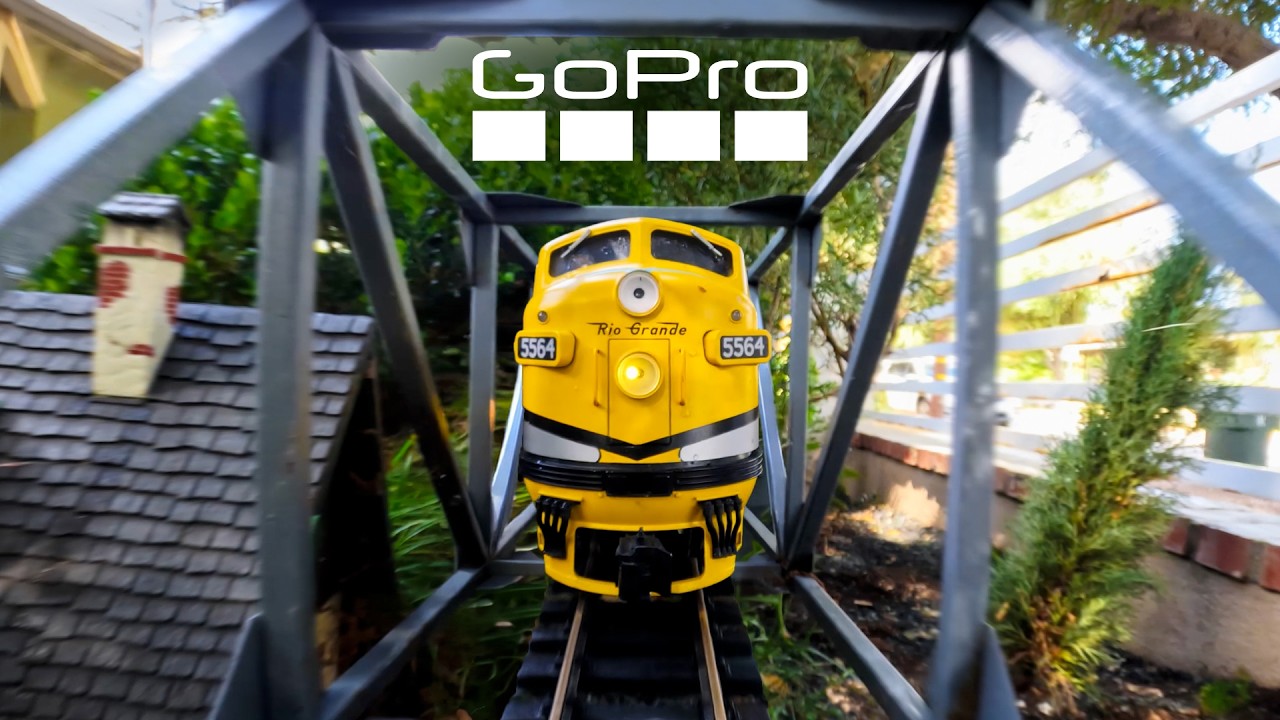
- The Miniature World of a Model Train Backyard
Take a ride along one of the most famous garden railroads on the internet.
- Leonardo's 280m Single Span Bridge Would Have Worked
Everyone knows that Leonardo was a brilliant artist and all-round polymath. We have, amongst other genius scribblings, his drawings for helicopters and parachutes - and a 280m single span bridge from 1502 which those clever people at MIT have now proved would actually have worked. Bridging the gap Leonardo da Vinci’s body of work has fascinated and inspired generations of thinkers across all fields. In his notebook sketches, we’ve discovered meticulous notes of anatomy, as well as drafts of inventions far ahead of his time. Amongst these, it appears Da Vinci tasked himself with an architectural challenge to bridge the gap between two cities. In 1502, Sultan Bayezid II of the Ottoman Empire - then the world's super power - began a search for a bridge design that would connect Constantinople (Istanbul) with its neighbouring city of Galata. This ambitious venture piqued da Vinci’s interest and he submitted his own bridge design in a letter to the Sultan. Although the bridge never materialized in the multifaceted inventor's own lifetime, the plans caught the intention of MIT engineers nearly 500 years later who asked themselves, “Could the design have actually worked?” The short answer: yes. Recent MIT graduate Karly Bast (pictured above) worked with professor John Ochsendorf and undergraduate student Michelle Xie to examine the problem. Together, Bast and her co-workers poured over the available documents, contemplated the possible materials and construction methods available to the time period, and considered the geological conditions of the proposed site - a river estuary called the Golden Horn. All of their research led to a detailed scale model that tested the bridge’s stability and capacity to support weight. Unsurprisingly, da Vinci passed the test with flying colors. How cool is that? Source: MyModernMet Even earlier than Leonardo da Vinci, the Czech city of Prague built its iconic Charles Bridge in the 14th century. Watch this magical animated 3 minute video to find out how...
- Good News Monday
What better way to start the week than with a global collection of good news nuggets? Credit: Douglas Crawford / Tree Wise Urban Forestry UK Tree of the Year Glasgow's Argyle Street ash (pictured) was voted Tree of the Year 2025 and now the shortlist for the 2026 competition has been revealed. “The ten nominees for Tree of the Year have all defied the odds in extraordinary ways, from clinging to cliffs and church towers, to enduring collisions and cannonballs. The big question now is: which tenacious British tree would you like to see crowned champion?” The public (the rules don't stipulate that you must be a UK resident) can vote for their favourite tree until 29 September. Even if you don't vote, the remarkable trees are definitely worth a look. A winner will be announced in October. Some Good Numbers 32: Countries that have eliminated the eye disease trachoma; El Salvador is the latest. 59: Percentage decrease in US deaths from coronary artery disease since 1990. 25: Percentage of Europe's electricity generated in June 2026; more than wind, fossil gas or nuclear, and a shrivelled 8 percent from coal. Solar has now become the EU’s single biggest source of electricity. 44GW: India is keeping pace with its ambitions to industrialise with sunlight rather than coal. The country added a record 44GW of solar in 2025/26, reaching 154GW in total. To prevent all that nice new clean energy getting wasted, Delhi is spending roughly $100 billion to expand transmission by 2032. 10 Years: The UN reports that over the last decade: Global internet access is up from 40 percent to 74 percent. About a billion more people enjoy clean drinking water. A billion and a half more people have better sanitation. 19 Months: As of April 2026, global solar capacity now exceeds 3 terawatts. The first terawatt took 20 years. The second took 33 months. The third has arrived in 19 months. Hector’s dolphin, a species set to benefit | Credit: Anjanette Baker, CC 4.0. BY-SA New Marine Protections In what is being described as an “important first step,” for marine protections in the island nation of New Zealand, five new marine preserves will enter into force next month. Near the southeastern tip of the South Island, 308 square miles of key marine habitats filled with charismatic species will gain protections under the new law. The reserves will be managed in partnership with the local Māori community, and be exclusive “no-take” areas. “This will be game-changing,” said World Wildlife Fund NZ’s conservation impact manager. NASA's Mesmerizing View of Earth's Ocean Currents Credit: Yan Hidayat Anyone There? A flying frog appears to be unperturbed as a snail settles on its head, and peers down into the frog's face. Photographer Yan Hidayat specialises in shooting wildlife in his native Indonesia. Syria Surprise Syria is planting lots of trees, restoring forest cover lost to war and wildfire, and so far they’ve avoided China’s biggest early mistakes: they’re replanting mostly native, climate-adapted trees that locals like and find useful (bay laurel, carob, olive, stone pine), and are trying to tackle the fuel poverty that drove much of the illegal logging in the first place - permitting legal wood harvesting and providing locals with subsidised firewood from forest thinning. AlpinSolar Solar Dam Switzerland has bolted 5,000 solar panels to an Alpine dam, where they work best in winter. The AlpinSolar plant on the Muttsee dam, about an hour outside Zurich, sits at 2,500m (8,000ft), way above the treeline, where thin air and snow-glare lift output. It generates roughly half its power in the coldest half of the year, around three times what a lowland solar farm manages, and at exactly the time the rest of the country runs short. The idea that once sounded absurd, solar in the snow, is now a blueprint that mountain regions across the world are studying. Meanwhile, solar panels are turning up in even stranger places, too. A Chilean salmon farm now draws over half of its power from panels laid over the water, cutting roughly 136,000 litres of diesel a year and silencing the generators. With the noise gone, thousands of salmon have gathered in the shade beneath the arrays. “Sunlight has to travel 93 million miles to reach the Earth, but none of those miles go through the Strait of Hormuz.” Bill McKibben On This Day 27 July 1866: First transatlantic telegraph cable comes ashore at Heart's Content, Newfoundland, after being laid out 1,686 miles from Valentia, Ireland, by Isambard Kingdom Brunel's Great Eastern steamship. It reduced message transfer time between Europe and North America from ten days by ship to mere minutes. Today's Articles Superhero Rescue: Spider-Man saves wheelchair user in Arkansas. Celebrity Bald Eagles: Jackie and Shadow raise $10 million to save habitat. 'Ready to Launch': 15 years after its retirement, Space Shuttle Endeavour is set to dazzle museum visitors like never before. Sensory Heritage: France protects rural sounds and smells in the face of complaints by city slickers. Mood Boosting Video Old Plastic Buckets: Is this the best street drum solo ever? Probably.
- Spider-Man Saves Wheelchair User in Arkansas
When a wheelchair user struggled to cross a busy 6-lane road, a superhero was on hand to help. Credit: Jonesboro Police Department Christopher Hellenthal, 20, was still wearing his Spider-Man costume after a superhero-themed event when he saw an opportunity to save the day. He leapt out of his car and wheeled the person to safety moments before the traffic lights changed. “I had a bunch of adrenaline pumping through me,” Hellenthal told The Associated Press, saying he had to act quickly in heavy midday traffic. “I was just kind of thinking, ‘I’m wearing this suit, it’s gonna be pretty funny.’” He was still garbed in his Spider-Man costume from a superhero-themed event at a trampoline park where he works when he spotted the person in traffic and ran out to help, declaring: “I got you.” Hellenthal swiftly rolled the person in the wheelchair to safety only seconds before the light changed and the rows of traffic advanced. The live-action superhero moment was captured by a street security camera in the city of Jonesboro and shared on social media by local police, who thanked Hellenthal for helping the man reach safety across the crosswalk. After rolling the man safely across the road, Hellenthal bolted back into his Jeep blocking traffic “because the light turned green pretty fast.” After the Jonesboro Police Department shared the video on Facebook, it quickly (and unsurprisingly) became a viral sensation, quickly accumulating tens of thousands of ‘likes’ on the social media platform.
- Jackie And Shadow Raise $10 Million to Save Habitat
Bald eagles Jackie and Shadow enjoy a certain level of celebrity status thanks to a live-cam broadcasting 24/7 from their home in Southern California, in the San Bernardino National Forest. Credit: FOBBV via YouTube A cleverly placed webcam has allowed tens of thousands of animal lovers to keep an eye on them - wherever they are in the world - as they deliver their eggs and wait for them to hatch in the weeks leading to the arrival of spring. The camera is managed by Friends of Big Bear Valley, an organization dedicated to protecting local animals through education and monitoring. They've been streaming from Jackie and Shadow's nest for years, sharing their family life with the public and providing priceless insight into the behaviour of these majestic creatures. Even revealing the birds' kisses before changing nest duty shifts. Today, the good news is that the land bald eagles Jackie and Shadow rely on for survival will remain intact. Friends of Big Bear Valley (FOBBV) has announced that they reached a goal of raising $10 million to purchase land around Big Bear Lake in the San Bernardino Mountains. A $5.5 million donation from Anna and Greg Brockman pushed the fundraiser to its goal ahead of a July 31 deadline. Greg Brockman is the co-founder and President of OpenAI, the company behind ChatGPT. Before the Brockmans’ donation, more than 25,000 donations had raised almost half of the necessary funds. “Greg and I are grateful to all those who championed saving the home of these majestic eagles, Jackie and Shadow,” Anna Brockman said in a statement. “Like many people around the world, we love watching them be amazing partners to one another and raise their young. They inspire perseverance and a sense of connectedness to something greater, to nature. We are proud to be supportive. We are so appreciative of the San Bernardino Mountains Land Trust and everyone who came together to preserve this incredible ecosystem, the life it will help sustain, and the forest that will be protected for generations to come.” The land that will be purchased with the $10 million is known as Moon Camp. This stretch of land has been a target of luxury housing and marina developers for more than two decades. But not any more.