Good News Monday
What better way to start the week than with a global collection of good news nuggets?

UK Tree of the Year
Glasgow's Argyle Street ash (pictured) was voted Tree of the Year 2025 and now the shortlist for the 2026 competition has been revealed. “The ten nominees for Tree of the Year have all defied the odds in extraordinary ways, from clinging to cliffs and church towers, to enduring collisions and cannonballs. The big question now is: which tenacious British tree would you like to see crowned champion?” The public (the rules don't stipulate that you must be a UK resident) can vote for their favourite tree until 29 September. Even if you don't vote, the remarkable trees are definitely worth a look. A winner will be announced in October.
Some Good Numbers
32: Countries that have eliminated the eye disease trachoma; El Salvador is the latest.
59: Percentage decrease in US deaths from coronary artery disease since 1990.
25: Percentage of Europe's electricity generated in June 2026; more than wind, fossil gas or nuclear, and a shrivelled 8 percent from coal. Solar has now become the EU’s single biggest source of electricity.
44GW: India is keeping pace with its ambitions to industrialise with sunlight rather than coal. The country added a record 44GW of solar in 2025/26, reaching 154GW in total. To prevent all that nice new clean energy getting wasted, Delhi is spending roughly $100 billion to expand transmission by 2032.
10 Years: The UN reports that over the last decade: Global internet access is up from 40 percent to 74 percent. About a billion more people enjoy clean drinking water. A billion and a half more people have better sanitation.
19 Months: As of April 2026, global solar capacity now exceeds 3 terawatts. The first terawatt took 20 years. The second took 33 months. The third has arrived in 19 months.

New Marine Protections
In what is being described as an “important first step,” for marine protections in the island nation of New Zealand, five new marine preserves will enter into force next month. Near the southeastern tip of the South Island, 308 square miles of key marine habitats filled with charismatic species will gain protections under the new law. The reserves will be managed in partnership with the local Māori community, and be exclusive “no-take” areas. “This will be game-changing,” said World Wildlife Fund NZ’s conservation impact manager.

Anyone There?
A flying frog appears to be unperturbed as a snail settles on its head, and peers down into the frog's face. Photographer Yan Hidayat specialises in shooting wildlife in his native Indonesia.
Syria Surprise
Syria is planting lots of trees, restoring forest cover lost to war and wildfire, and so far they’ve avoided China’s biggest early mistakes: they’re replanting mostly native, climate-adapted trees that locals like and find useful (bay laurel, carob, olive, stone pine), and are trying to tackle the fuel poverty that drove much of the illegal logging in the first place - permitting legal wood harvesting and providing locals with subsidised firewood from forest thinning.

Solar Dam
Switzerland has bolted 5,000 solar panels to an Alpine dam, where they work best in winter. The AlpinSolar plant on the Muttsee dam, about an hour outside Zurich, sits at 2,500m (8,000ft), way above the treeline, where thin air and snow-glare lift output. It generates roughly half its power in the coldest half of the year, around three times what a lowland solar farm manages, and at exactly the time the rest of the country runs short. The idea that once sounded absurd, solar in the snow, is now a blueprint that mountain regions across the world are studying. Meanwhile, solar panels are turning up in even stranger places, too. A Chilean salmon farm now draws over half of its power from panels laid over the water, cutting roughly 136,000 litres of diesel a year and silencing the generators. With the noise gone, thousands of salmon have gathered in the shade beneath the arrays.
“Sunlight has to travel 93 million miles to reach the Earth, but none of those miles go through the Strait of Hormuz.” Bill McKibben
On This Day
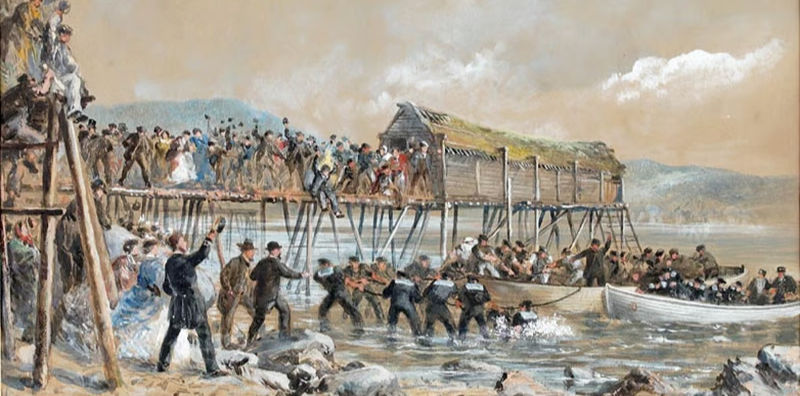
27 July 1866: First transatlantic telegraph cable comes ashore at Heart's Content, Newfoundland, after being laid out 1,686 miles from Valentia, Ireland, by Isambard Kingdom Brunel's Great Eastern steamship. It reduced message transfer time between Europe and North America from ten days by ship to mere minutes.
Today's Articles
'Ready to Launch': 15 years after its retirement, Space Shuttle Endeavour is set to dazzle museum visitors like never before.
Sensory Heritage: France protects rural sounds and smells in the face of complaints by city slickers.
Mood Boosting Video
Old Plastic Buckets: Is this the best street drum solo ever? Probably.