8 Unforgettable Things to Do in Gyeongju
Gyeongju was the capital of the Silla Kingdom for nearly a thousand years, and the city still
carries that history in a way few places in Asia can match.
Royal tombs rise like grassy hills in the middle of downtown neighborhoods, ancient Buddhist carvings sit tucked into mountainsides, and entire lakes were engineered centuries ago for royal leisure. This isn't a place with one or two must-see landmarks - it's a place where the whole city functions as an open-air museum. Here are eight experiences that make a trip to Gyeongju worth planning around.
Walk Among the Royal Tombs at Daereungwon: Daereungwon is a walled park in the center of Gyeongju holding 23 tomb mounds from the Silla period, some dating back to the 4th century. The tombs look like smooth, grass-covered hills, and walking the paths between them at dusk, when the park lights come on, is one of the more atmospheric things you can do in the city. One tomb, Cheonmachong, is open to visitors and displays a replica of the gold crown and other artifacts excavated from inside. Set aside at least an hour to walk the full loop.
See the Stargazing Platform at Cheomseongdae: Cheomseongdae is a stone tower believed to be the oldest surviving astronomical observatory in East Asia, built in the 7th century during the reign of Queen Seondeok. It stands about 9 meters tall and is made from 362 stones, a number some historians tie to the days of the lunar calendar. The structure itself is modest in size, but its age and purpose make it a genuinely rare artifact. It sits within walking distance of Daereungwon, so pair the two on the same visit.
Explore the Buddhist Art at Bulguksa Temple: Bulguksa, a UNESCO World Heritage Site, is considered one of the finest examples of Silla-era Buddhist architecture in Korea. The temple grounds include two stone pagodas, Dabotap and Seokgatap, that have stood since the 8th century and appear on Korea's 10-won coin. Wooden halls, stone bridges, and carved staircases are arranged across terraced grounds that reward slow walking rather than a quick pass-through. Arrive early in the morning to avoid the tour bus crowds that build up by midday.
Visit the Seokguram Grotto: A short drive up the mountain from Bulguksa, Seokguram Grotto houses a granite Buddha statue seated inside a domed stone chamber, facing out toward the sea. Built in the mid-8th century, the grotto is often paired with Bulguksa on the same UNESCO listing and the same day trip. Visitors view the statue through a glass barrier rather than entering the chamber directly, which helps preserve the site but is worth knowing ahead of time. The mountain setting and the view over the valley below add to the experience even before you reach the statue itself.
Ride Around Bomun Lake: Bomun Lake is a reservoir on the eastern edge of Gyeongju, developed decades ago into a resort area with a paved path circling the water. Renting a bike here is a popular way to cover the roughly 4-km loop, passing cherry trees, small bridges, and lakeside cafes along the way. In spring, the blossoms along the path draw visitors specifically for that stretch of scenery. Many of the city's larger hotels in Gyeongju cluster around this lake, making it a convenient base if a relaxed, resort-style stay matters to your itinerary.
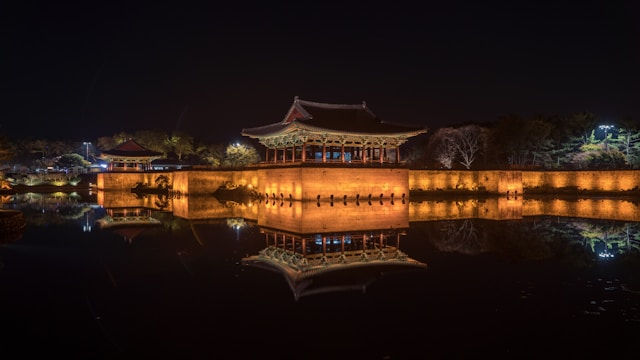
Walk the Donggung Palace and Wolji Pond Grounds at Night: Donggung Palace and Wolji Pond, formerly known as Anapji, was once a secondary palace used for royal banquets and receiving foreign envoys. What makes this site distinct is how it looks after dark: the restored pavilions are lit and reflected in the pond's still water, creating one of the most photographed nighttime scenes in the city. Excavations here also turned up thousands of artifacts, some now displayed at the nearby Gyeongju National Museum. Plan to arrive right around sunset to catch the transition from daylight to the lit-up night view.
Browse the Gyeongju National Museum: The Gyeongju National Museum holds one of the country's largest collections of Silla artifacts, including gold crowns, Buddhist statues, and the massive Divine Bell of King Seongdeok, cast in 771. The bell alone is worth the visit - it's one of the largest bronze bells in Korea and is tied to a well-known (if grim) legend about its casting. Exhibits are organized clearly enough that a visit of 90 minutes to two hours covers the highlights without feeling rushed. This is a useful stop for context before or after visiting the tomb sites and temples scattered around the city.
Wander Through Yangdong Folk Village: About a 20-minute drive from downtown, Yangdong Folk Village is a Joseon-era settlement still lived in today by descendants of the original noble families. Traditional tile-roofed houses and thatched-roof homes sit among terraced hillsides, arranged according to Confucian principles of family hierarchy. Unlike some restored "folk villages" built for tourism, Yangdong is a UNESCO-listed site that has remained continuously inhabited for centuries. Walking its quiet lanes gives a different sense of history than the temples and tombs - one centered on daily life rather than royal power. Gyeongju rewards visitors who slow down rather than rush between landmarks. Spacing these eight stops across two or three days, rather than cramming them into one, leaves room to actually absorb what each site represents instead of just checking it off a list.