Behind The Scenes of Companies Scaling Seamlessly in The Digital Age
You’ve seen it happen: A company goes from “promising up-and-comer” to “everywhere”
without melting down in public. No weeklong outages. No angry social feeds. No apology tour
from the CEO filmed in a dimly lit office.

Here’s the cheerful secret. The smoothest growth stories are usually powered by people doing the quiet work that keeps customers happy while the business gets bigger. And if you want help finding the kind of partners who respect that behind-the-scenes grind, you can reach out to DesignRush. Let’s take a walk backstage.
The Calm You Notice is Built on Purpose
When a company scales well, you feel it. Pages load. Orders go through. Support answers you like a human, not a wall. Your login works on the first try. That “it just works” feeling is not luck. It’s the result of teams building habits that make chaos less likely. The goal is simple: When demand jumps, the experience stays steady. And yes, there’s usually a moment when a team realizes growth has arrived, not as a trophy, but as a line of people waiting at the door.
Meet the Quiet Heroes
Every smooth growth story has a cast. You just don’t see them taking a bow.
The support rep who spots a pattern in new tickets and calls it out before it becomes a
full-blown fire.
The operations lead who notices a handoff that’s slowing everything down and fixes it
in a day.
The engineer who worries about boring things like capacity and backups so you don’t
have to.
The product manager who says “not yet” to a shiny feature because the basics need to
hold.
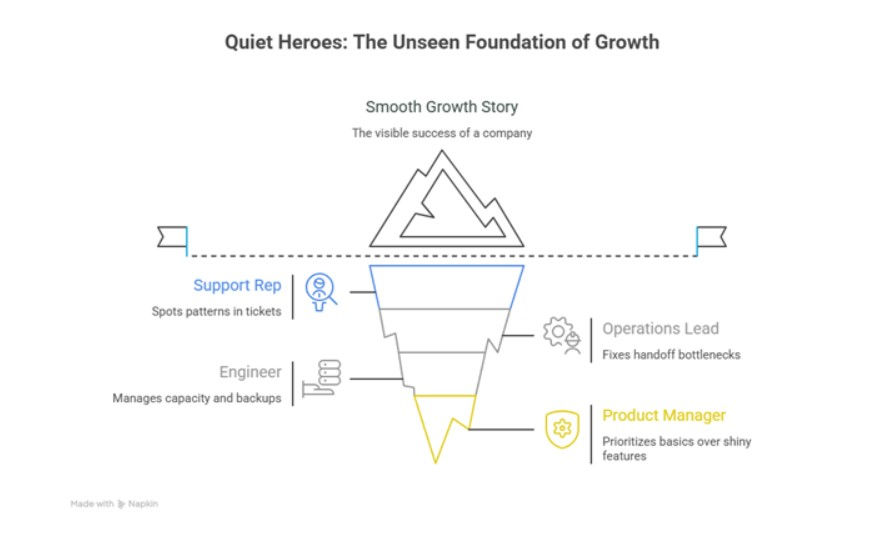
These roles aren’t glamorous, but they are the reason a company can grow without turning your life into a customer-service scavenger hunt.
The Real Behind-The-Scenes Work Looks… Normal
Here’s what scaling often looks like on a Tuesday:
A support team rewrites a help article because people keep asking the same question.
The question isn’t dumb. The writing was unclear. So they fix it.
A developer removes a step from checkout. Not because it’s trendy, but because it
keeps failing on older phones.
Someone in finance asks a simple question: “Are we sure this new tool is worth the
monthly fee?” That question saves money, sure, but it also cuts down on tool overload,
training time and confusion.
And a manager finally admits the obvious: “We can’t run this place on Slack messages
and vibes.”
None of this makes headlines. All of it keeps a business from wobbling when things speed up.
The Small Fixes That Save the Day
Seamless scaling is often a stack of tiny decisions that add up to a big result. Here are a few that show up again and again.
They write down the important stuff: If your company depends on one person who “just knows,” that’s not a system. That’s a cliff. High-growth teams document basics early:
How to handle refunds.
What “urgent” means.
Who approves what.
How to roll back a bad release.
It’s a map that keeps new hires from guessing at the rules.
They protect the customer’s time: Smooth companies treat your time like it matters. Because it does. They watch for friction: repeated logins, confusing forms, slow pages, unclear emails.
They fix the stuff that makes people sigh. They cut steps. They tighten copy. They reduce the
number of times you have to “try again.” Customers may not send a thank-you note for a cleaner checkout. But they come back. And they tell friends.
They keep the tech boring on purpose: There’s a myth that scaling means adding more tools, more features and more everything. Often, the opposite is true. The most stable systems are the ones that do a few key things well. The best teams keep their setup clear enough that new people can understand it fast. They retire tools that don’t pull their weight. They simplify flows that have grown messy over time.
Culture Is Part of the System
Scaling isn’t only about code and processes. It’s also about how people act when pressure
shows up. Smooth-growth teams tend to:
Talk about problems early, before they get big.
Admit mistakes without turning every issue into a blame game.
Reward people for preventing fires, not just putting them out.
Keep meetings tight and decisions clear.
The Customer Experience
When a company scales, internal teams can get so focused on growth metrics that they forget
the one metric customers notice: “Did this go smoothly?” The companies that grow without drama keep returning to the basics:
Can the customer complete the main task quickly?
Do they understand what happens next?
If something goes wrong, can they reach a real person?
Does the company communicate clearly, without excuses?

The behind-the-scenes heroes care about these questions. They think about the customer
who’s tired, busy, or on a lunch break. They build for that person, not an ideal world where
everyone has perfect Wi-Fi and unlimited patience.
The Moment When Growth Gets Real
There’s usually a day when a company feels the shift. A feature goes viral. A big partner signs
on. A campaign lands better than expected. A holiday rush hits early. Suddenly, the volume is
real. The teams that scale well don’t panic. They triage. They pick what matters most. They push fixes that protect the core experience. They communicate in plain language. They take notes, so the next spike is easier.
Closing Thoughts
The internet loves a big, dramatic growth story. But the best ones are often the least chaotic.
They’re built by teams that respect the basics, sweat the details and care about how it feels to
be the customer. So, the next time you use a service that just works (even when everyone else is also using it), take a second to appreciate the quiet heroes. They’re the reason your day stays on track.