
OGN Wednesday
Mid-week collection of uplifting news nuggets from around the world.

And The Winner Is...
Every year, photographers from around the world capture extraordinary moments that reveal the beauty, diversity, and importance of our oceans - and the 2026 UN World Oceans Day Photo Competition has just announced this year's winners. Top prize for the 'Big and Small Underwater Faces' category went to this intimate portrait of a whale. Here's what the photographer said: "A curious juvenile gray whale approaches our boat in a lagoon in Baja California Sur, Mexico. This was an incredibly special encounter, as the whale spent over an hour with us, coming in close enough for me to dip my camera into the water and capture this image. These whales are known for their friendly and inquisitive nature, and seem to genuinely enjoy interacting with humans."
What People Ate
You may like to take a look at this interactive exploration of 19th-century New York restaurant menus that reveals American social history through what people ate and how they ordered it. A History of Menus is a Menu of History.
1 Woman & 47 Men
That is the gender split for head of medical staff at the men's 2026 World Cup. Dr Suzanne Huurman is only the third-ever female team doctor in the 96-year history of the tournament as head of medical staff for Curacao's national men's side - the World Cup's smallest-ever team by population and size. When Fifa explained to Dr Huurman she was the only female head of medical staff in the 2026 World Cup, she didn't think much of it. "I didn't realise in the beginning because it's so normal to be the only, or one of the few, women in the room. But I hope to see more women soon because there are a lot more women out there who are capable." Brazil-born Dr Huurman has worked with Real Madrid, Go Ahead Eagles and PSV Eindhoven.

Zero Emissions
Swiss locomotive manufacturer Stadler and Sardinian regional operator ARST have unveiled the world's first hydrogen-powered train built for narrow-gauge track. That's a genuine first because the narrower track imposes axle-load limits so tight that no existing hydrogen train could fit, and an entirely new vehicle had to be designed from scratch. However, the Sardinian project diverges sharply from other European hydrogen trains - which have to stop to refuel. This one will generate its own hydrogen entirely through solar-powered electrolysis, integrating the production plant directly into the transport network. The result is a system that produces no emissions at any stage, from solar energy generation through electrolysis to propulsion - something no active hydrogen rail project in Europe currently achieves.
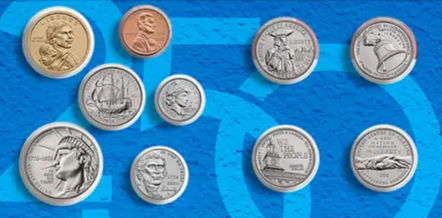
Birthday Coins
An uncirculated set of coins featuring change marking America's 250th birthday has been released by the US Mint, just days ahead of the nation's anniversary on July 4. The coins include the quarter, dime, nickel and penny, as well as signature coins, all with unique elements and features emblematic of the nation's milestone. You can hold national history in your wallet.

It's Good to Laugh
If you could use another reason to smile today (who couldn’t?), a recent study found that laughter may be more universal than we thought - with great apes like chimps, gorillas, and bonobos chuckling in a similar way to how we humans do. Not only that, but this way of laughing could go back 15 million years, revealing a window into the evolution of speech. Researchers found that all the laughs followed a surprisingly similar rhythmic pattern, with evenly spaced intervals between successive sounds. They noted that human laughter has evolved over the years to be variable depending on context (e.g., an uncontrollable belly laugh differs from a polite chuckle). But the essential structure of a laugh has not. “By comparing how different species laugh, we can see that a basic rhythmic structure has remained unchanged since our last common ancestor,” study co-author Chiara De Gregorio said in a statement. “That’s extraordinary.”
"Summer afternoon; to me those have always been the two most beautiful words in the English language." Henry James
On This Day

1 July 1836: President Andrew Jackson announced to Congress in 1835 the extraordinary bequest from British scientist James Smithson. He left his entire estate - amounting to 104,960 gold sovereigns - to the United States to found an establishment in Washington "for the increase and diffusion of knowledge among men". Today, in 1836, Congress officially authorized the acceptance of the Smithson legacy and pledged the nation's faith to the charitable trust, worth roughly $20m in today's money. Thus, the Smithsonian was born.
Today's Articles
Mood Boosting Video
Midsummer Coupé: Morgan's most ambitious hand-built commission yet.


