Swirling Book Sculpture in Prague Library Becomes Tourist Hotspot
Almost 30 years after a dizzying sculpture fashioned from books was first installed inside the Prague Municipal Library in the Czech Republic, it has suddenly taken on a new lease of life thanks to social media.
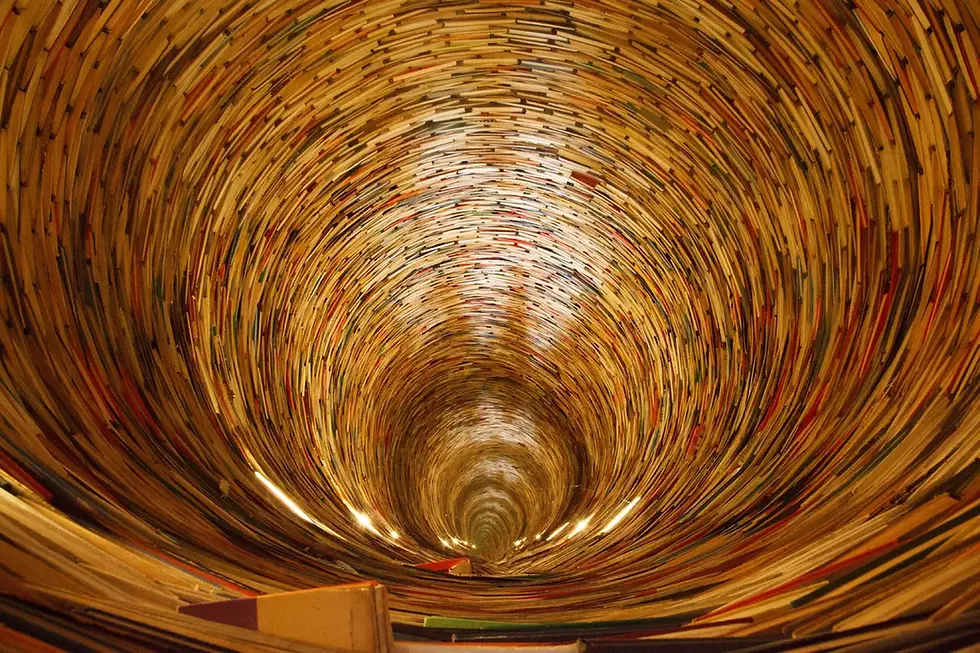
Idiom, created by Slovak artist Matej Krén in 1998, involves about 8,000 books stacked into a circular tower that is about 20 feet tall. Mirrors placed on the top and bottom give the illusion of infinite length, and a narrow raindrop-shaped entryway invites visitors to peek inside the wormhole - almost like they’re literally disappearing into a good book - and, of course, provides the opportunity of a marvellously intriguing and impactful photo opportunity for anyone and everyone with an Instagram account seeking to impress their followers.
The library's website says that “The Idiom is meant to symbolize the infinity of knowledge. Books are like bricks to Matej Krén, but they contain much more information, destinies, stories and knowledge. He puts them into the form of dwellings: primitive on the one hand, infinitely intelligent on the other.”
For many years, Idiom was only known to regular library-goers in the Czech capital. But a couple of years ago someone posted an image on BookTok, the part of TikTok dedicated to discussions of books and writing - and, hey presto, it went viral. Algorithms on Instagram similarly pushed the sculpture to the forefront of feeds.
“Kids that were in Prague looking into their phones suddenly saw a cool thing that they liked and they wanted to see it as well,” Czech journalist Janek Rubeš told Radio Prague International. “And as it is in today’s world, everyone wants to have the same picture or same video, because it looks cool and they can get likes.”
Today, librarians and local tourism officials are astonished at the foot traffic the sculpture generates. During peak travel seasons - such as Christmas and Easter - more than 1,000 people each day come to snap a photograph, with queue times of up to two hours. As a result, the library has now introduced a special entrance for these visitors and is contemplating the idea of charging for access.