
OGN Monday
Ensuring December gets of to a bright start with today's global round up of good news nuggets.

Tour de Farce
A grumpy, obnoxious tour guide in Germany is proving an unlikely hit with visitors to Düsseldorf’s Kunstpalast museum. Joseph Langelinck, whose sell-out €7 tours are billed as “highly unpleasant”, admonishes his customers for their failure to answer questions about the works he shows them - often treating them to loud tuts or eye-rolls. “I never insult visitors directly,” says Carl Brandi, the performance artist behind the Langelinck character; rather, he tries to make the group as a whole “feel as ignorant as possible”. But, people clearly love it.

Windsor Castle
It's that time of year again. Royal staff putting the finishing touches to the decorations on the Christmas tree in the Crimson Drawing Room at Windsor castle - the oldest and largest occupied castle in the world, founded by William the Conqueror in the 11th century.
Secret Ballot
An international society for cryptographers has had to scrap its committee election, after - somewhat hilariously - they were unable to decipher the results. Members of the International Association of Cryptologic Research used a “secret digital ballot whose final tally could be decoded only by using three keys split among select election trustees”, said The New York Times. But one of the trustees misplaced his key, leaving organisers “with no choice but to throw out the vote and call a new election”.
Five Brain "Epochs"
In one of the world’s most comprehensive studies of how neural wiring changes from infancy to old age, scientists in Cambridge have identified the five major “epochs” of human brain development. Analysis of almost 4,000 MRI scans shows the brain shifts through five distinct wiring phases, with major transitions at the ages of nine, 32, 66 and 83. Adolescence appears to run from nine to the early 30s, the only period when neural networks become more efficient. The findings should help explain age-linked risks across mental health and dementia.
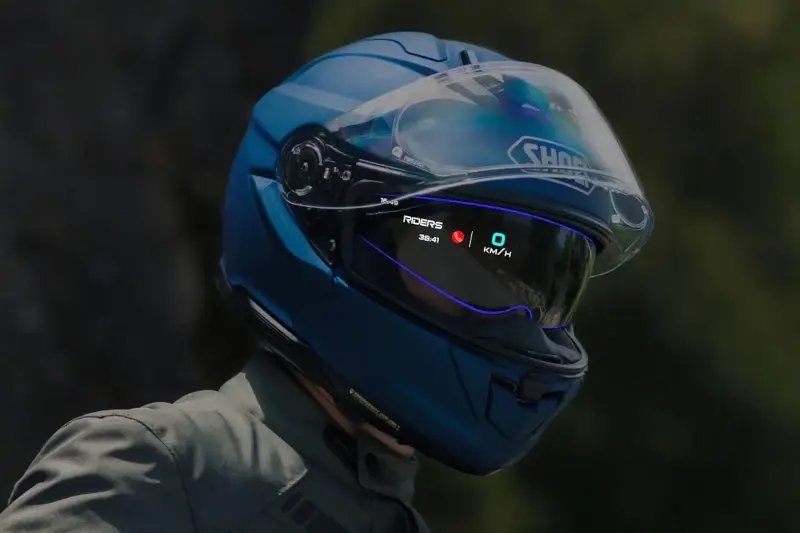
World's First AR Helmet
Shoei has launched the world's first helmet with fully integrated AR. The idea is simple: You get to keep your eyes on the road instead of gazing down at a dash or handlebar-mounted phone. Simply peek slightly upward to glance at all the info you need. Info such as speed, GPS navigation, calls, and radar warnings are all projected in the field of vision at a perceived distance of three meters. Shoei says that this tech cuts reaction times by more than a third. Big numbers! Pricing for the GT-Air 3 Smart comes in at US$1,199. But, if it helps keeps drivers alive, it's got to be worth it.
mRNA Flu Shot
In a Phase 3 trial of more than 18,000 volunteers across three countries, an mRNA influenza vaccine from Pfizer has outperformed standard seasonal flu shots by 34.5 percent. It's yet another sign that this biotechnology is here to stay. Making mRNA vaccines is significantly faster than developing traditional flu shots, which rely on growing the virus in eggs or cells - a process that can take six months or longer. Quick turnaround would mean vaccines could be developed in response to more currently circulating flu strains, potentially better protecting people from serious illness.

Fishing Therapy
After fishing turned out to be the saving grace during his recovery from a decade of mental health struggles and alcohol addiction, an Englishman wanted to hook others; his idea is now being prescribed by doctors. His service has partnered with the UK’s NHS to prescribe angling for anxiety and depression, and has just been honoured by King Charles - winning the King’s Award for Voluntary Service, the business equivalent of an MBE. “I’m just ecstatic!” said Dave Lyons, the founder of Tackling Minds.
“Think before you speak. Read before you think.” Fran Lebowitz
On This Day

1 December 1913: The world's first moving assembly line debuted, used in manufacturing Model Ts at a Ford factory in Highland Park, Michigan. This system dramatically reduced the time to build a Ford Model T from over 12 hours to about 90 minutes by having each worker stand in one place and add a specific part as the car moved past on a conveyor belt. This new method made cars more affordable and accessible to the average person, significantly changing the automobile industry and manufacturing worldwide.
Today's Articles
One Simple Thing: Discover the multiple health benefits of drinking a glass of lemon water in the morning.
Mood Boosting Video
A Critter Carol: Woodland animals discover a lost iPhone and use it to film themselves singing a song of friendship.


